.png)

UCLA NICU
General NICU Info
Residents - please review the NICU specific website created by the NICU team prior to the start of the rotation:
https://mednet.uclahealth.org/nicu/
(Please review in particular the video orientation and resident guidebook including how to present TPN/enteral nutrition)
Goals of our RR NICU experience include fostering a comfortable resident learning environment and providing high quality patient care.
Check out the "Pathways & Protocols" above for many commonly used NICU algorithms, organized by system!
Daily tasks:
-
Receive sign-out
-
Sign into Vocera “RR NICU Resident”
-
Log on to Care Connect context “MD PED NEONATOLOGY”
-
Assign yourself to your patients on Care Connect
-
Introduce yourself to your patients’ bedside nurse
Expectations:
-
Deliveries: Attending deliveries is optional, but highly encouraged.
-
Please note: Residents will still be responsible for writing the H&Ps/doing admission orders for the NICU admit when the infant is admitted to the resident team regardless of delivery attendance.
-
Touch times: 7:30 am to 8:00 am. Please introduce yourself to the nurse caring for your patient before doing your physical exam and ask them if it is an appropriate time. If there is unprofessional behavior, please notify the charge nurse, your fellow, your Chief Resident, and/or Jess Lloyd with the specifics. We are here for you!
-
Please make sure the correct resident is updated on care connect to ensure that the RN can page you directly instead of paging/calling the fellow first.
-
All day residents are generally expected to stay until sign-out to ensure that all tasks are completed and to minimize multiple hand-offs. It is important to discuss with the attending and fellow if you are planning to leave early to ensure there are no pending tasks, impending admissions/transfers, or educational activities.
NICU Policies:
-
To help prevent infection in our littlest ones, please help by respecting the following policies:
-
Please hang your white coat at the entrance of the unit.
-
Remove rings with high set profile/raised gemstones (wedding bands okay), bracelets and watches. Large safety pins provided to secure jewelry to scrubs if preferred).
-
Please scrub at the sink when you enter. All healthcare personnel must apply the Sterillium gel scrub upon initial entry in the NICU daily (total of 4 pumps: one in each hand to clean fingertips to wrist & then 2 more pumps for forearms to elbows).
-
Place personal electronic devices (cell phones) in clear plastic bags provided.
-
Follow proper hand hygiene and universal precautions between patients/individual patient care areas (bedside)
-
Eating is permitted only in the staff lounge (where the TV and coffee are). No eating or drinking in the NICU provider room except a covered spill-proof drink container is ok. Soda cans do not count as covered drinks. No straws. A sealed drink is allowed while rounding and in the pods. Drinks must be in a spill-proof sealed container and placed at the designated ‘hydration stations’ in the unit (shelf behind the charge nurse desk and center tables in each pod).
-
Do not place soiled/used PPE (masks, gloves, bonnets, etc.) on top of workspace areas (alcove fronting pod 5, conference room, front desk, reception area, etc.). Dispose of these in proper lid-covered waste containers only.
-
Please review the policy for what to do when you're sick in the NICU
-
Residents should be instructed to minimize direct patient contact when possible.
-
When in direct patient contact, they will perform a) hand hygiene, b) place face mask/gloves, c) provide care, d) remove gloves/mask, & e) perform hand hygiene.
-
Use proper face mask in the unit at all times except when eating and drinking.
-
Residents with high fever (>100.4) and/or diarrhea will be excused from all clinical duties.
-
-
The charge nurse, NICU fellow, and chief resident are available to help with any questions.
-
Supplemental Learning:
Please review these helpful podcasts by NICU Alumni Dr. Seth Langston. Topics include: 1) Enteral nutrition 2) Total fluids and TPN 3) Respiratory disorders 4) Respiratory support 5) PDA 6) Prematurity comorbidities. These podcasts have an accompanying printed out curriculum in the unit which you can go through with a fellow or attending.
UCSF NICU protocols
Tala Talks NICU
Iowa Neonatology Handbook | University of Iowa Stead Family Children's Hospital
Home | Newborn Nursery | Stanford Medicine
The NICU Doc
Sridhar K
Journals: NeoReviews, Journal of Perinatology
Books: Gomella, Fanaroff, Avery's, Broadsky and Martin
Daily Schedule:
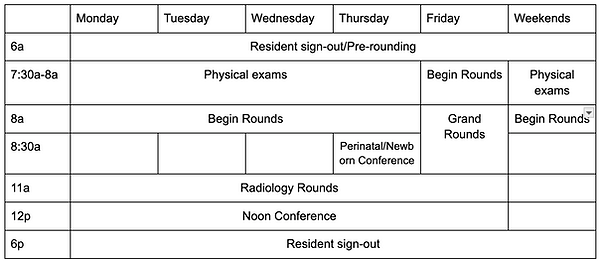
Arrive at 6:00 AM to receive signout from the overnight resident, then pre-round
-
Touch times to do exams (7:30-8:00 AM)
-
Resident to sign into the Vocera at start of shift by joining “RR NICU Resident.”
8:00-8:30 AM:
-
Every other Thursday, there is Perinatal/Newborn Conference from 8:30-9:30AM. Every Friday, Grand Rounds are from 8:00-9:00AM. On these days, work rounds begin early at 7:30AM.
8:30-10:30 AM: Rounds
-
Write orders for each other on rounds
-
Finalize TPN orders. Ideally, TPN is signed on rounds, but if it needs to be adjusted after rounds for the sake of efficiency/rounding time management, orders should be in by ~ 12PM.
11:00-11:30 AM: radiology rounds
12:00-1:00 PM: Noon conference
Mandatory on Monday, Tuesday, Friday. Exception: on Wednesdays and Thursdays, residents are to attend NICU specific conference from 12:30p-1:00p.
NICU conference zoom log in:
https://uclahs.zoom.us/j/98534762405?pwd=MqcSnTtiNWPSaHe8O51nvtIaJezgWq.1&from=addon
6:00 PM: Sign out to night resident. It is a good idea to make a “to do” list for the on-call resident and to pass off important social information that may be relevant overnight and when a patient has a modified CODE status. At the start of the night shift it is good practice to check in with the night fellow and make a plan for the night (when to confirm TPN volumes, important to do’s, unstable babies to get a baseline exam on).
~9:30 PM: Night rounds with fellow and charge nurse. Time subject to change depending on census and unit activity.
5:00 AM: Meet with night fellow to pend TPN based on AM electrolytes.
Common Definitions:
Neonate: Less than or equal to 28 days
Infant: 29 days – 1 year
Child: > 1 year
Preterm: < 37+0 weeks
Post-term: > 42 weeks
Small for gestational age: BW < 10 percentile
Average for gestational age: BW 10 – 90 percentile
Large for gestational age: BW > 90 percentile
Macrosomia: BW > 4000g
Average term infant birth weight: 3.5kg
Average term infant birth length: 50 cm
Average term infant birth head circumference: 35 cm
Pre-rounding Numbers:
-
Day of life (DOL), Corrected Gestational Age (CGA), Post Menstrual Age (PMA)
-
Daily weight in grams, % lost if still below BW (% lost = new weight/birth weight x 100) note how many grams lost or gained in 24 hours (e.g. today’s weight is 2400g, which is down/up 10 grams from yesterday)
-
Vitals (temp, heart rate, mean arterial pressure, respiratory rate, SpO2)
-
Present only the information that is relevant to your patient. For example, if you are presenting a term infant who does not qualify for a retinopathy of prematurity exam, then there is no need to mention ROP at all.
Neuro:
-
Apnea/brady/desats (number, duration, what kind of intervention required, specific pattern such as with feeds only)
-
NPASS scores, abstinence/eat sleep console scores, WAT scores (neonate on sedatives, actively weaning, neonatal opioid withdrawal syndrome (NOWS))
-
Head circumference (OFC)
-
Cranial ultrasound for IVH screening or other indication, if applicable
-
Other head imaging (CT, MRI)
Resp:
-
Invasive vs non-invasive ventilator settings, nasal cannula flow rate, FiO2, blood gas (pH/CO2/PaO2/HCO3/Base). Know whether your blood gas is an ABG vs VBG vs CBG to aid with interpretation.
-
Tip: Infants with no access generally get capillary blood gas unless specifically requested otherwise. Infants with arterial access will generally get ABGs, infants with UVCs, PD PICCS or Broviacs will generally get venous draws. Blood draws cannot be taken from a PIV or NeoPicc.
-
CXR
CV:
-
Always know your access! Knowing what kinds of access you have and may need helps you interpret your lab draws and will often impact your plan (for example: Is a line expiring and are you in need of a new one, or is a PIV sufficient? Is the line malpositioned, no longer drawing, or not providing the right kind of data we need (i.e have a venous line, but need arterial draws, or invasive BP monitoring?))
-
If central line: what kind of central line, where is it located, how many days old, how can we reduce how many times we break into the line, is the central line still indicated?
-
Ensure weekly imaging for all central lines. Knowing what line you have determines the kind of imaging you need. For ex: a RUE PD PICC only needs a CXR, not a babygram. In contrast, a LLE PD PICC would need a babygram.
-
ECHO/EKG results, lactate/BNP/troponins
FEN:
-
Ins and Outs: Report net balance, total fluid goal (cc/kg/d), total fluid (actual) intake (cc/kg/d) and total kcal (kcal/kg/d) intake; to calculate kcal:
-
breast milk/formula = (volume in mL)(20kcal/30mL)
-
dextrose in TPN = (volume in mL)(%D)(3.4kcal/g)/(100)
-
amino acids in TPN = (volume in mL)(%AA)(4)/(100)
-
lipids = (volume in mL)(2kcal/mL)
-
For omegavan, 1 mL = 1 kcal
-
-
-
TPN composition: GIR (mg/kg/min), AA (g/kg/d), IL type and dose (g/kg/d).
-
Note: The dextrose % and AA % are not helpful values to report as what we are interested in is the GIR and how many g/kg of nutrients a baby is getting.
-
-
Calculated metrics on progress notes will automatically calculate enteral (formula or breastmilk feeds) calories only for the last 24 hours from 7AM to 7 AM. Use the dot phrase: .infantenterictotals.
-
Note: the smartphase only works if nursing inputs both a volume and caloric density for every enteral feed and if the dosing weight has been updated in the last 14 days. Feeding volumes and caloric densities are charted in flowsheets. Dot phrase for TPN and fat calories is launching soon!
-
-
Electrolytes, accuchecks
GI:
-
Abdominal girth, stools, emesis/residuals
-
Abdominal imaging
Renal:
-
Urine output
-
Renal imaging
Heme:
-
CBC, transfusions
-
Bilirubin level, risk factors for hyperbilirubinemia, phototherapy threshold
ID:
-
Medications and expected duration of antibiotic course
-
Susceptibilities
-
Relevant cultures
Tips
-
Interval events: often better to include in the data presentation to avoid significant overlap. However, major changes such as intubation, self-extubation, decannulation from ECMO, or CODE events should be mentioned here.
-
Keep diagnoses updated, move things to inactive when able
-
Avoid repeating data in your plan.
-
Some attendings prefer data with assessment and plan by organ system, some prefer data and assessment and plan separately, some attendings have no preference at all. Clarify this on your first day with attending.
Notes:
To start a new note, search for SmartText by typing “NICU”
-
H&P: “IP PED NEO NICU HISTORY & PHYSICAL ADMISSION NOTE UCLA”
-
Progress note: “IP PED NEO NICU PROGRESS NOTE UCLA”
-
D/C summary or hospital course: “IP PED NEO NICU HOSPITAL COURSE & DISCHARGE SUMMARY UCLA”
-
When transferring a baby to the peds floor, NBN, CTICU, or PICU, take your hospital course and change the text in the document (not in the note type box) to TRANSFER summary.
Orders:
Mondays:
-
Update dosing calc weight (located in the lower left column) for each patient after discussion on rounds; some patients do not use their actual weight as the dosing weight due to fluid overload. This is important for everyone on a team to know so that new medications ordered are ordered at the dosing weight, not the current weight. It is also important for the team ordering TPN to know if the dosing weight is significantly different from the actual weight as this impacts the volume ordered.
-
Use birth weight as dosing weight until infant has regained birth weight, except perhaps in the situation of significant fluid overload since the baby was born.
-
Go through each medication and gtt on rounds and decide if you want to dose adjust the medication or not. Do not weight adjust all medications before rounds as it is a more complex decision that should be discussed with the team.
-
Most medications will be dose adjusted except medications that a patient may be weaning off of (diuretics, caffeine, sedation drips, steroids) or finishing a course of (antibiotics).
-
Report growth parameters (weight by grams/day in the last week, OFC by cm/week, length by cm/week) and Z scores for %iles and growth velocities.
Labs:
-
See TPN tab for TPN lab monitoring.
-
Anemia of prematurity: Minimum weekly CBC for < 1500 g preterm infants until 1 month of age, and then check PRN. Goes along with checking iron studies. See Growth Labs document.
-
Iron studies: Collect CBC, retic, ferritin every 1 week with Fe dose change, every 2 weeks while titrating/monitoring, can space out checks when on a stable dose of iron with goal ferritin and retic hemoglobin content. Goal retic hemoglobin > 28, goal ferritin > 75 and < 400. Retic hemoglobin content is a superior marker of iron stores and ferritin can be impacted by systemic inflammation, but the retic hemoglobin is not. See Growth Labs document.
-
Osteopenia of prematurity screening: After four weeks of age, collect alkaline phosphatase, phosphorus. Check every 2 weeks until normal. Growth Labs document on Box for detailed indications on Osteopenia of prematurity screening.
-
Pre-Op labs: Generally, CBCd, coags, BMP. BMP should be drawn same day as procedure. CBCd and coags are often okay to be drawn day before so there is time to correct abnormalities. Hematocrit goals can be discussed with CT NP or cardiology if it is unsure whether a baby should be transfused. Prior to a procedure, also order the proper decontamination set based on the procedure baby is going for and age.
Team Caps and Patient Distribution:
-
Please see the team caps and workflow policy here
-
Distribution of new admissions between the resident and NNP teams will be determined by the fellow and attending depending on the number of patients on each team, their acuity, any movement occurring in the unit with transfers in and out, and any special circumstances. The best ways to get a sense for expected admissions would be to:
-
Check in with the fellow in the morning before rounds about any possible admissions and who the fellow believes the patient will be assigned to (however please be flexible as the number of patients on a team can change quickly).
-
If you feel overwhelmed with the number and/or complexity of your patient load, please speak to the fellow and/or attending to discuss practical ways to manage the load (and re-distribution if required).
-
Some attendings and/or fellows will "run the board" 5 min prior to rounds to discuss the census and "patient movement" (who is being transferred, who needs to be transferred and to where, planned discharges, obstacles to transfers/discharges, planned/upcoming admissions, and who is going to the OR, MRI etc). Please feel free to join these discussions.
-